Monday, January 12, 2026
This Monday, January 12th, Sacrilegious Cinema: Menagerie of Madness submits a double feature dealing in masked murderers of whodunnit horrors, evoking a breath of giallo riddled within the fabric of the films. This ghastly duo explores both sociological and psychological perspectives, with the first providing a feministic focus on stardom and beauty standards, while the latter concentrates on religious affliction, critiquing Catholicism and dissecting familial dysfunction under such a lens.
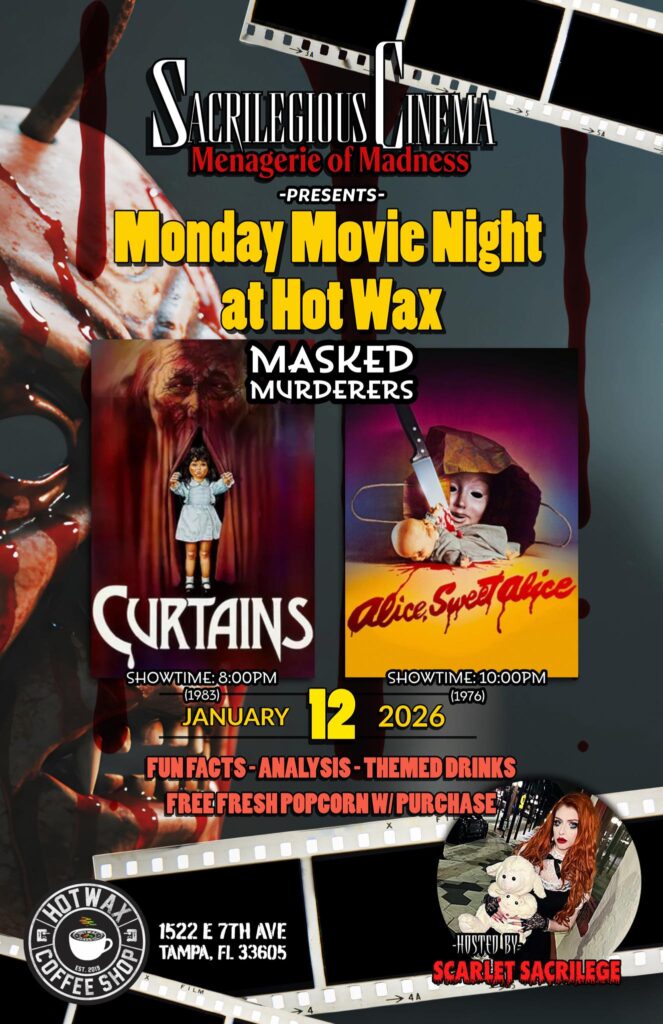
First up, at 8PM, we peel back the CURTAINS (1983) to watch a group of aspiring actresses attend an audition to die for- in this psychological whodunnit slasher hybrid, the seedy underbelly of the industry, including the infamous casting couch- is exposed and exploited, with each women desperate for a shot at the silver screen, their fate ultimately decided by a sleazy director pulling the strings.
Curtains is a slow burn slasher flick- an odyssey of the incessant sexism in show business cataloging the lengths women are driven to in order to obtain an impossible standard set by society. Directed by Richard Ciupka and starring renowned leading lady Samantha Eggar of brilliant body horror masterpiece ‘The Brood’ (by David Cronenberg) as well as Lynne Griffin of Black Christmas (1974) fame, Curtains spotlights a cast of characters differentiated by their occupations outside of acting, incorporating these trades into not only their personalities but also their demise, helping to better distinguish them from one another.
Apart from the brilliant narrative, Curtains offers a gorgeous setting against the unforgiving wintry landscape where the film’s most infamous scene takes place. Moreover, the stage sets make for interesting antics, emerging as the perfect venue for a cat and mouse chase, whilst doubling as an allegory for deceitful appearances, leaning into the fantasy of the silver screen, harboring the implication that not all is what it seems with movie magic- in addition to the dazzling facade sported by celebrities for public consumption. The reoccurring motif of mannequins and dolls sprinkled throughout functions as a symbol of beauty and pain- as both possess undying beauty, but with this blessing is bestowed a burden of pain.
The hag mask is particularly effective in this arena, serving as the antithesis of all that is glamorous in its menacing realism. The mask reflects the anxieties of every starlet- because in Hollywood, there is no worse a fate than being washe d up and haggard.
Curtains digs deep into the dark side of stardom when pertaining to women, addressing a systematic dehumanization and objectification through narrative devices, characterizations, dialogue and symbolism, immersing viewers into a foreboding atmosphere of unease.


Then, at 10PM, we turn back time to 1961 and visit the parish of Paterson, New Jersey for little Karen Spages’ first holy communion- but to the family’s utter chagrin, a murderer enters their midst, donning a yellow raincoat and cheap Halloween mask to commit a series of brutal attacks beginning with Karen herself (portrayed by Brooke Shields in her film debut) where suspicion falls on older sister Alice in an ode to Italian horror whodunnits, integrating itself within the league of proto-slashers sprung from gialli fashion.
ALICE, SWEET ALICE (1976) remains a hidden gem among the horror genre, serving as a study of corruption in Catholicism through the vehicle of a psychological slasher. The theme of punishment, religious guilt, and perversion of purity thrives in this underrated whodunnit. Alice, Sweet Alice plays out much in the spirit of a giallo, throwing out red herrings left and right, and leading viewers astray as to the identity of the raincoat clad killer. The wardrobe for the perpetrator- including the translucent Halloween mask- proves effectively eerie in spite of its simplicity; the combination of these otherwise ordinary items becomes uncanny and harrowing when united.
Director Alfred Sole takes advantage of the gritty atmosphere, contrasting it with a beautiful color palette of foreboding pastels. The score, inspired by Hitchcock’s Psycho, enhances the building suspense with each death scene and offers musical dissonance.
There lies an element of voyeurism to the film, with shots of peepholes leaving a lingering feeling, as though the viewer spies on a private familial dysfunction.
Alice, Sweet Alice markets enticing character profiles, diving into mental illness within the confines of a deconstructed sociological environment. The movie, rife with religious iconography, adds another layer of complexity to the fractured psyches ahead, with attention to anguish and hysteria of biblical proportions- Alice, Sweet Alice ignites a running motif of holy depravity, examining the violation of being born out of wedlock, wherein the offspring inherits parental sin, enacting a self-fulfilling prophecy of delinquency. Moreover, the topic of divorce amid a Catholic community is breached, amplifying debauchery from weighing public opinion. Sociopathic tendencies and a sacrilegious psychosexual fixation are exemplified by the titular Alice, outlining an analyses on the resulting repercussions of zealotry infecting not only a dysfunctional family tree, but a scathing societal condemnation. Religion breeds repression in the context of this film, creating an undeniably blasphemous undertone. 


Come out to Hot Wax Coffee Shop in Ybor City for some deep cut carnage.
FREE popcorn included with a
mandatory purchase- no cover charge with a 1 drink (or snack) minimum from the bar.
(Movie nights offer psychological insight accompanied by behind the scenes information and observations by your horror hostess).