
Monday, May 11th, 2026
Sacrilegious Cinema: Menagerie of Madness bears witness to the monsterhood of mothers in this tribute to their passing day- assessing two matriarchs and their devious offspring to satiate audiences appetite for mayhem, bringing a new meaning to mommy issues. Slide back into the 1960s in the advent of visceral horror boring into the innards of the psychological with this classic duo teeming with solitude, identity, and autonomy wrapped in spine-chilling suspense prescribing paranoia for the ages.
At 8PM, we honor our mothers with an exercise in the Oedipal complex in the form of Norman Bates. But before we meet the momma’s boy in question, we accompany Marion Crane on the run with a sum of money she stole to start a new life with her boyfriend, Sam Loomis. As Marion drives from Phoenix to California, traversing the backroads to avoid apprehension until she stumbles upon a desolate lodging with a stopover at the Bates Motel for some much needed shuteye.
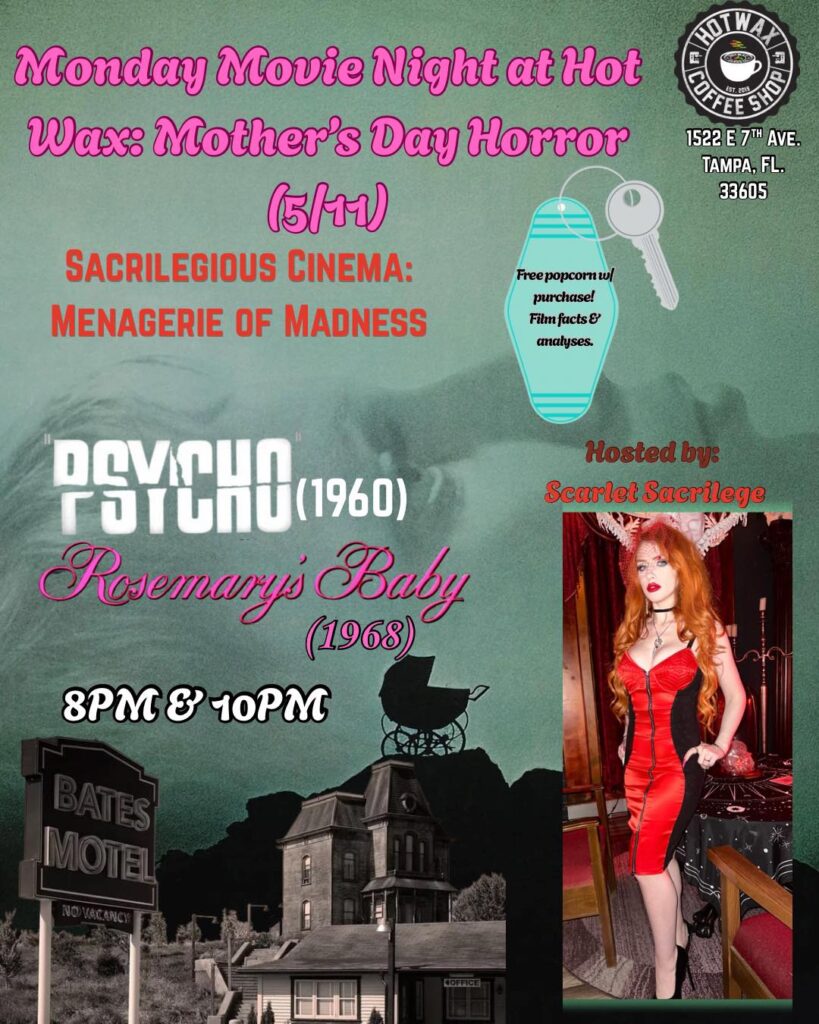
The proprietor, seemingly kind, albeit incredibly awkward, Norman Bates, maintains a complicated relationship with the matriarch of the motel- his elderly, infirmed mother, Norma, whom he cares for in spite of her domineering demeanor. Peer into the fractured psyche of Mr. Bates and examine the destructive kinship in a clash of personalities and maternal enmeshment. Through this parasitic dynamic, we address loneliness, isolation, and compartmentalization- amongst other psychological conditions ailing the murders and mommy issues. Alfred Hitchcock’s revolutionary PSYCHO (1960), often classified as the grandfather of the slasher subgenre, weaves an unnerving narrative of mystery and intrigue, rife with twists and turns mapped throughout its duration. This early effort into this variety of horror is dubbed responsible for instilling the fear of showers into viewers for the last several decades since its pivotal release. With an orchestral score of frenetic chords implemented by composer Bernard Herrman so recognizable it’s inseparable from its visual counterpart, Psycho infuses anxiety amongst audiences of all ages. Adapted from a story published a year earlier by Robert Bloch, and converted into a screenplay by Outer Limits show runner Joseph Stefano, a merging of masterful minds collide to birth a classic in the annals of horror cinema. This year, you don’t have to be alone in your own private trap. 🪤🏨 🦅 🚿🔪💀
Then, at 10PM, we meet the titular Rosemary Woodhouse and her husband, Guy, in their move into a New York City apartment, where they intend to start a family— but as time passes by, Rosemary becomes increasingly convinced her nosy neighbors are embroiled in a perverse plot involving her pregnancy, suspecting Satanic allegiance in the assembly. ROSEMARY’S BABY (1968) presents a nose-dive into the Satanic Panic sub-genre of the 1960s, dousing the narrative in a psychological slowburn rooted in realism, perusing themes of paranoia with gaslighting, ultimately extending into control and coercion from the patriarch— lending a feministic perspective to the picture. Moreover, Rosemary’s Baby serves as possession of bodily autonomy, ripping away agency from women’s rights to choose, reflected in the oppression of Rosemary. Monstrosity in motherhood is further examined through the protagonist’s conditioning into the cult, single-handedly institutionalizing maternity to govern the feminine and deny independence from said faction, only allowing one to operate under the approval of androcentrism- especially concerning the self-sacrifice of women to benefit male prosperity.
A seminal entry into the archives of cinema, Rosemary’s Baby emerges as the pinnacle of Roman Polanski’s apartment trilogy, surveying the horrors of urban alienation, and the lack of privacy in domestic spaces, cultivating a sinister claustrophobia rife with intrusive parties, peeling back the veil of mental maladies guised by a veneer of normalcy. This invasion of peace fractures Rosemary’s well-being, further crippling her fight for sovereignty. Adapted from Ira Levin’s best-seller by the same name, Rosemary’s Baby remains fully faithful to its source material, posing a question of identity within the confines of motherhood amidst the patriarchy. Produced by famed horror legend William Castle and carried by a gut-wrenching performance by leading lady Mia Farrow, earning her many accolades for her spirit, Rosemary’s Baby persists as a monumental film worthy of more than just horror fans’ attention- with its myriad of symbolism and meticulous detail, Rosemary’s Baby creates a dread-inducing atmosphere for viewers to stew in days post viewing.🍼🗽🧺
Come out and indulge in the celebration of motherhood and the matriarchy.💗🎀
FREE popcorn included with a mandatory purchase- no cover charge with a 1 drink (or snack) minimum from the bar.
(Movie nights offer psychological insight accompanied by behind the scenes information and observations by your horror hostess).