
Sunday, August 9th, 2026
Sacrilegious Cinema: Menagerie of Madness takes a trek back into Texas to get a taste of that southern hospitality people are always raving about for yet another year- featuring the grisly seminal classic The Texas Chainsaw Massacre coupled with its darkly comedic twin flame sequel spawned from the 1980’s- Tobe Hooper serves audiences the best of both worlds.
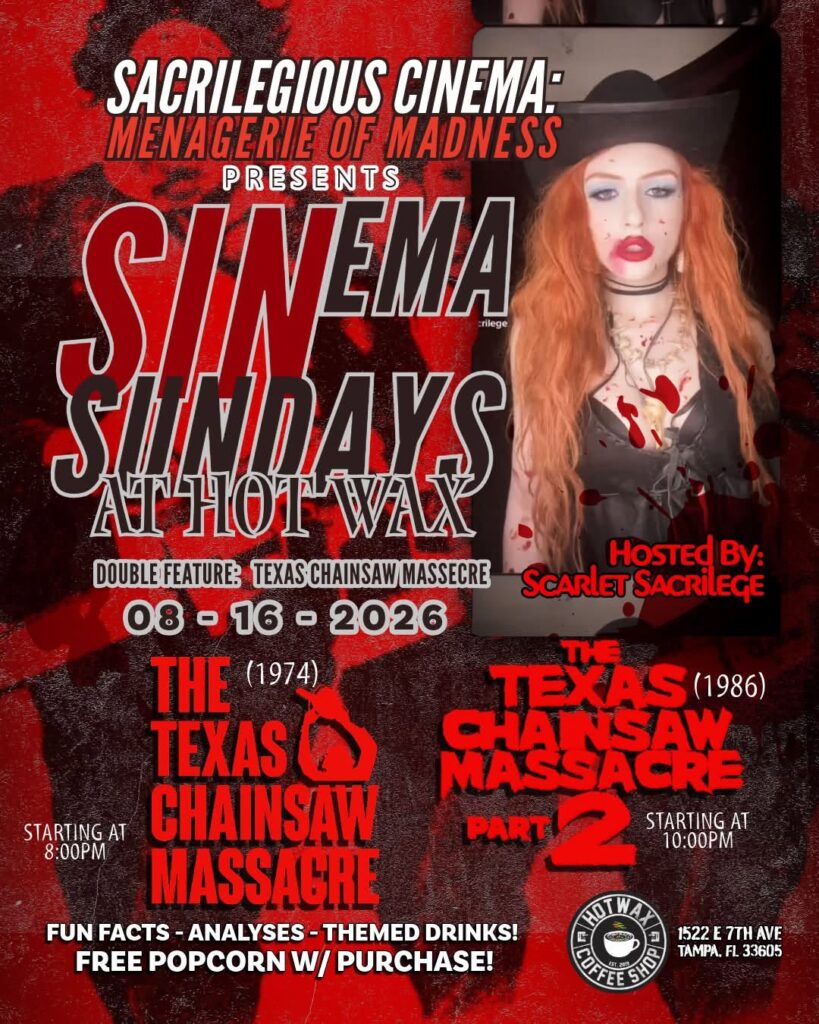
At 8PM, in honor of the anniversary, we revisit the events of August 18th, 1973- and honor the victims of what authorities dub ‘ The Texas Chainsaw Massacre’- inspired by the likes of Ed Gein himself in a modern cautionary tale of cannibalism amidst an economically depleted and socially desolate landscape, digging into one of the most influential (proto)slashers of all time. Join Sally Hardesty and friends to make a pit stop of peril during a road trip across Texas where they meet the acquaintance of a dysfunctional family- “For them, an idyllic summer afternoon became a nightmare.”
Tobe Hooper’s THE TEXAS CHAINSAW MASSACRE (1974) is an exercise in brutality- with most misremembering it as particularly graphic, there is very little blood and gore- instead relying on the power of suggestion to allow the minds of audiences to fill in the blanks. In many ways, this film does not deserve its sanguinary reputation- however, it is not what is shown, but implied that leaves a lasting impression on the most fearsome of horror fans. Texas Chainsaw does what most films fail to do without the presence of gore, with subliminal messages alone to disgust the masses.
The raw documentary style feel adds credibility to the assumption that this is in fact real event despite only loosely based on the heinous crimes of Ed Gein.
Family values are dismantled with dysfunction while the state of cultural norms and mores are made a mockery of. In addition to an Armageddon atmosphere fit with astrology as a means of foreshadowing accompanied by recurrent solar flares. All such elements offer a glimpse into the political war ridden climate of the U.S., even of not of a domestic nature, the ramifications of war still manage to cause ripples amongst civilians.
At the helm with Hooper, Robert Burns is the mind behind the stellar set design- while Gunnar Hansen breathes life into the otherwise mute Leatherface, cementing him as a classic horror icon contrasted by Marilyn Burns, manifesting an early example of the final girl trope.
The score is entirely organic in that Hooper did not employ any instruments but instead industrial noises to accomplish a gritty, rustic ambience. Copyrighted songs are only present in a diegetic fashion, permitting the scenes to speak for themselves with only roars of the chainsaw and high pitched screams to fill the void of sound- especially chilling paired with the flashbulb introductions against beams of decaying corpses becoming instantly recognizable in relation to the Texas Chainsaw franchise.
It is undeniable the immense influence this picture has had the slasher subgenre but as well as horror as a whole- from the town local harbinger of gas, to the shady gas station, to the prototypical final girl; many things that may seem cliche now were original at the time of release and contributes to its prototype-slasher status.
Its success is evidenced by how ubiquitous it has become in pop culture- existing in copies, homages and even parodies. This movie sets itself apart from the other exploitation flicks of the era, paving a path for future landmark pictures such as Halloween and Friday the 13th.
Part of the charm is the extremely low budget allowing for unintentional authenticity in some areas, once again uplifting the inventive nature of independent Guerilla filmmaking.
Then at 10PM, we track the whereabouts of the Sawyer family to their lair, where the Cook participates in best chili competitions with a secret ingredient everyone is dying to get a taste of, wherein Tobe Hooper leans into the black comedy peppered throughout its predecessor for a worthy albeit tonality divergent sequel.
This sequel to the original nightmare fuel, forged again by Hooper himself promises a bloodbath in addition to its departure from the darkened mood of its antecedent to distinguish itself as opposed to repeating the formula of its family member. THE TEXAS CHAINSAW MASSACRE PART II (1986) sets a precedent for successors in its blatantly campy albeit creepy approach, all while falling in line with the age of the era, dripping in satirical wit with the same dose of charisma fans recall. This terrifying chapter introduces the iconic character of Chop Top- the equally eccentric twin of Nubbins Sawyer (formerly known as ‘The Hitchhiker’) depicted by Edwin Neal in the aforementioned; after Hooper watched Bill Moseley play a reincarnation of the Hitchhiker in the short The Texas Chainsaw Manicure, Hooper created Chop Top specifically for Moseley, securing him as a genre legend. Moreover, Dennis Hopper of Lynch’s esteemed Blue Velvet embodies another wacky persona in this Texas Chainsaw sequel, this time as a rogue law enforcement official, hellbent on avenging his deceased niece and nephew from the previous tale. Rounded out by Caroline Williams of later scream queen fame as our determined final girl, and character actor Jim Siedow reprising his role as the deviant Drayton Saywer ‘The Cook’, giving us a feel for continuity. With the heir to the 1974 classic amping up both the comedy and carnage, Tom Savini emerges as the man behind the makeup, paving way for some gruesome special effects in juxtaposition with its less is more earlier effort.
Come hang out with me at Hot Wax Coffee Shop for a venture into the perversion of the American Dream and deep dive into social distortion. 


FREE popcorn included with a mandatory purchase- no cover charge with a 1 drink (or snack) minimum from the bar. Remember to try our themed drinks for this week’s Texas Chainsaw Massacre double feature.
(Movie nights offer psychological insight accompanied by behind the scenes information and observations by your horror hostess). 